Menu

My Mission
Articles
Podcast
Events
Workplace Education
Clinician Education
Newson Clinics
Hormones Unlocked
Books
Research
Media
Contact

Balance App
Track symptoms, get insights and feel more in control.


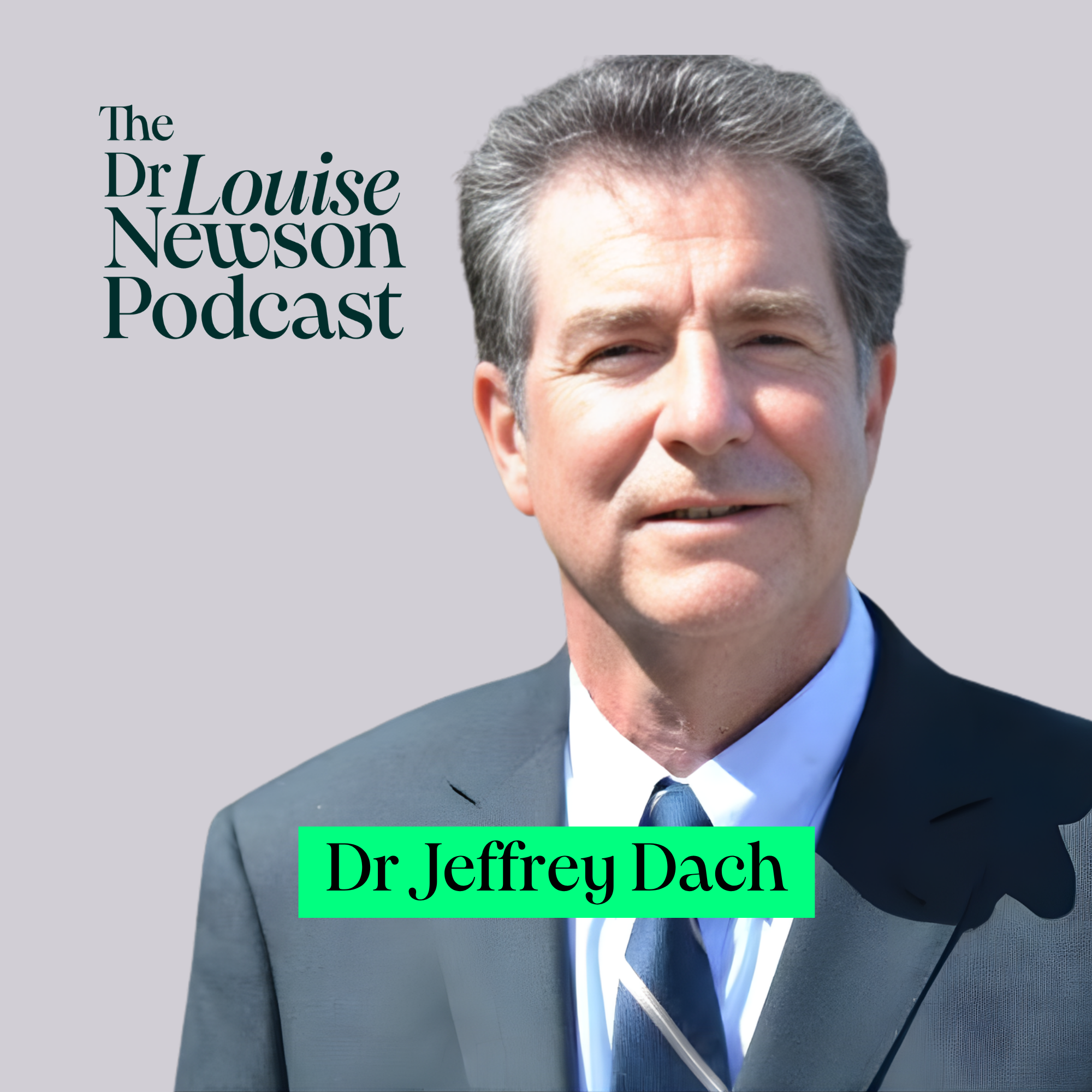
In this episode, Dr Louise Newson is joined by physician and author Dr Jeffrey Dach, who is the founder and Medical Director of the TrueMedMD Clinic in Florida and author of numerous books including Bioidentical Hormones 101.
Together, Louise and Jeffrey challenge some of the biggest myths surrounding hormone treatments, including the long-standing fear around breast cancer and the lasting damage caused by the Women’s Health Initiative study.
They discuss the important differences between body identical and synthetic hormones, and why hormones should be recognised not just for symptom relief, but also for their roles in improving long-term health.
It’s a powerful conversation about fear, misinformation and why so many women are still being denied the hormone treatments they both need and want.
Dr Louise Newson: [01:00:00] Dr Jeffrey Dach is my guest today. He's a US doctor and he talks a lot about the preventative roles of hormones, talks about how estrogen can reduce future risk of breast cancer but also other diseases such as osteoarthritis, osteoporosis and heart disease. We really explore about how we should be thinking differently about hormones and also about how healthcare professionals should be less scared of prescribing hormones to women.
Dr Louise Newson: [01:00:32] Jeff, I'm really excited to have you on my podcast because I've listened to quite a few podcasts that you've been on on other people's. Your words of wisdom, your huge intellect is just incredible. And also your book, which I have lugged down to London on the train last night, Bioidentical Hormones 101: Menopausal Hormonal Replacement, second edition I'd just like to add. So just before we get started just tell me a bit about you because you haven't always been a specialist in hormones. So can you just tell me a little bit about your story?
Jeffrey Dach: [01:01:09] Yes, of course. First of all, Louise, thank you so much for inviting me. It's a great honour to be on your podcast. And you know, my background, I started out as a diagnostic interventional radiologist. I worked in the hospital for 25 years doing that. And, you know I developed eye trouble. So I switched to a outpatient clinic. I started my own outpatient clinic here locally, and doing bioidentical hormones at the beginning and then I later, as, as I, we were chatting earlier, I mentioned that I became a reluctant thyroidologist and, uh, we have a second book the Natural Thyroid Toolkit, which, you know, we can get into later, but, um, yeah, you know I was prescribing bioidentical hormones for 20 years, the first edition of the bioidentical hormone book came out in 2011, and we talked about the you know, the Women's Health Initiative study. And at that time there was, it was a different environment. There was just a lot of negative newspaper articles on bioidentical hormone replacement. So a lot are the chapters on the first book dealt with that. The first edition is free on my website. You can download the free version. We now have since 2011, you know another 14 years of research, a lot new material, a lot of new information, which is that really changes the whole landscape and plus I put it out monthly newsletter and must have tonnes and tonnes of material on bioidentical hormones from the newsletter, so I had enough material for a book, so, I started putting it together and realised, you know what? There's a lot of medical research that needs to go in the book, which I haven't looked at yet. So, as you know, writing a book like this, you get it's takes on a life of its own. And so, you know, that's what goes into the book. You have these little, these moments where the little lightbulb turns on, you know the Eureka moment. So we do have a few of those in the book and I you know, I think it's a good book. I'm a little biased since I wrote it, and you know and one of the things that we talk about is. The Women's Health Initiative, 18-year, 20-year follow-up data came out and showed this tremendous protective effect of estrogen. The estrogen-treated group had a 45% reduction in mortality from breast cancer and I love the quote from Isaac Manyonda, who is there in London. I think he's at St george. he's a professor at St george in London, and I think he's one of your favourites also.
Dr Louise Newson: [01:04:08] Indeed.
Jeffrey Dach: [01:04:08] He comes out and says, you know what? Looking at this new evidence, you're compelled to come to the conclusion that estrogen does not cause breast cancer, but it's actually preventive. He's quoted prominently in the book and then the other thing that I didn't know, which I discovered writing the book is there is a difference between Premarin, which is the hormone estrogen they used in the Women's Health Initiative. There's a difference between Premarin and estradiol, which is the human, you know, the strong, the human hormone E2, which is the major strong hormone. And the difference is horses, you know, Premarin comes from pregnant horses. Horses have these these estrogenic compounds that do not appear in humans. [01:05:06][57.8]
Dr Louise Newson: [01:05:07] It's very interesting because the biggest reason, I think, or the commonest reason that people are not taking hormones for perimenopause and menopause, and not prescribed hormones, is this unfounded fear of breast cancer because of the WHI, like you say, the Women's Health Initiative study, because the way it was misreported to the lay media and the medical literature as well, that HRT causes breast cancer. You know, when you unpick the literature, now we've got the luxury of time where we can look at longer term data, like you say, this risk of breast cancer hasn't actually ever been shown with estrogens, either estrodial, estriol or the conjugated equine estrogens in a pregnant horse's urine. But actually for you to say, there's a 45% reduction in mortality so death from breast cancer and it showed that there was about a 23% reduction in incidence of breast cancer, like why wasn't that headline news? I find that is so important when breast cancer is so common that that's just been dismissed, hasn't it?
Jeffrey Dach: [01:06:16] Well, you know, the, the newspapers got it wrong and of course there was that, in 2002, when the first arm of the study was published, which uses, which used the Premarin along with the synthetic progesterone, the medroxyprogesterone, MPA for short, that, you know, that was the one that, showed increased risk of breast cancer. The study was halted before it became statistically significant. And then, you, know, if you look at the later follow up 18-year follow up. There was an increased number of deaths from breast cancer in the synthetic progestin group. It was roughly the placebo group had about 40 deaths from breast cancer in the 18-year follow-up. The Premarin group had almost half that, 22 deaths compared to 40. And then the Premarin plus medroxyprogesterone MPA group had 60 deaths from breast cancer. So, if you compare the formula in the first arm that was published in 2002, which is the, the Premarin plus MPA to the Premarin alone, that's going to be statistically significant in terms of, you know, 60 deaths versus 20. So the statement that, oh, there is no study showing that MPA is, you know increases mortality from breast cancer with, there's no statistician that within, with statistical significance that's, you know, I think that's a little deceptive just to make that statement because number one, the studies are halted early before they can reach significance. And it's, you know, to me it's obvious that if you power a study and follow it long enough, you're gonna see, you now, that type of significance in the numbers. You know in terms of synthetic progestins being carcinogenic, you we know that for example, So there's a, you know, you go to the university animal lab in the neighbourhood and ask the people, the researchers in their little white coats, how do you give mice breast cancer? And one of the techniques that's widely available is the they inject the mice with medroxyprogesterone. There's so many studies now which show that adding a synthetic progestin to estrogen will increase the risk of breast cancer. The one that's quoted the most is probably the French cohort study by Agnes Fournier, and she found that roughly 48% increase in breast cancer compared to placebo when the medroxyprogesterone is added to estradiol. And when estradiol is combined with progesterone, natural progestrone, there was no increased risk of breast cancer. You know, the hazard ratio goes back down to 1.0 and then, you know, you can look at the monkey studies. We have an entire chapter in the book entitled, don't monkey with my hormones which is supposed to be cute and, you know, we have these monkey labs, you know the Macaque monkeys have menstrual cycles very similar to humans, and their physiology response is very similar in terms of response to hormones and breast cancer physiology. And they, so, you know, Charles Wood compared medroxyprogesterone to estradiol and to Premarin. He did all those monkey studies and he found that Premarin is much less proliferative than this estradiol. And then if you add medroxyprogesterone to estradiol, it becomes even more massively proliferative. And there are studies done by, the one that I quote the most was done by Sebastian Giuliani from Argentina. He's a colleague of Claudio Laneri, who did the MPA mouse studies and he found that when you use medroxyprogesterone added to estrogen, it upregulates ERα, and then he found activation of oncogenes that are very well known in the oncology literature. Medroxyprogesterone activates breast cancer oncogenes.
Dr Louise Newson: [01:11:06] Which is very, it's very interesting because, you know, people just think a hormone is a hormone and over here, and actually not just in UK and other countries as well, doctors, nurses, pharmacists are quite happy to prescribe these synthetic hormones, in good faith, they're using them as contraceptives, but I remember going to a talk at a menopause society meeting several years ago and they were talking about the dangers of bioidentical hormones. And I had not really heard this phrase, bioidentical. I didn't really know what it meant. And they were talking about the compounding of how people have hormones made and they should all be regulated from pharmaceutical companies. But certainly in some countries, it's not possible to obtain estradial or testosterone unless it's compounded. And in my mind, bioidentical doesn't really matter where it's made. It just means it's the same chemical structure as the hormone that we make ourselves as in estradiol or estriol or testosterone or progesterone. But there's been so much confusion on the words and even when you talk about MPA, medroxyprogesterone acetate, it's not progesterone, it shouldn't even have that word in its description. So it causes no end of confusion but metabolically and biochemically they work so differently in the body, don't they? These synthetic chemical hormones.
Jeffrey Dach: [01:12:36] They have very opposite actions in terms of breast cancer and also in a neurosteroid, neuro protect, you know, the progesterone, natural progesterone is very neuroprotective with all of those neuroprotective properties are completely obliterated by synthetic progestins. You know, we do in here in the US we do have FDA approved versions of pretty much all of the biodentical hormones in use, in hormones in the human body There are versions of estrogen, you know there are estradiol patches that are FDA approved, progesterone, micronized progesterone oral was approved in 1998, FDA approved in 1988. It was manufactured by Solvay at the time and that study showed that it prevented endometrial hyperplasia. Also testosterone is FDA approved, versions of that. So estriol is more, I think approved in Europe, more of an approval in Europe. So here in the US, if we want to use estriol, we have to use that through a compounding pharmacy. There are FDA approved versions of the estradiol patch and testosterone at the local pharmacy. The reality is FDA approval doesn't necessarily mean you're dealing with a good drug. 10% of FDA approved drugs are later actually withdrawn from the market because, you know, they're bad drugs and another 10% are given the black box warning, which, you know, means this is probably a bad drug. When I think about compounded, compounding pharmacies, they do vary quite a bit in quality, you know, there are little mom and pop compounding pharmacies, you know on the street corner down the street and then there, we have these large compounding pharmacies that, that specialise in women's hormones. There's about half a dozen around in the US and those are the ones that we use, they have much higher quality, much more quality control. And this is another thing that we don't have to worry about. You know, I look at compounded hormone formulations as sort of a generic form of the FDA approved version. So, you know, it's an awful, I can, I look at it as, as off-label prescribing of a generic version. You, know, 20% of all prescriptions in the United States are prescribed off-label. There's no FDA approval for that indication, you know, that's a big chunk of medical practice right there. So, you and the other thing to think about is, here in the US, every hospital pharmacy is a compounding pharmacy. So, you know, they try not to use compounded formulas. I mean, if they can take something off the shelf, they'll prefer that. But, you know, in the hospital, when they make up an IV bag, or you know there's a significant chunk, a significant percentage of the medications that they make up are compounded. In every hospital in the United States, so if you get rid of compounding, it's gonna be a problem for the hospital system. [01:16:01][205.8]
Dr Louise Newson: [01:16:04] I'm really excited to announce that I've written a new book. It's called The Power of Hormones. It looks at how hormones actually work in our body and why so much of what we've been told and taught, especially as women, has actually been wrong. I explore the science, the history, and the uncomfortable truths about how hormones have been misunderstood, under-taught, and often dismissed within medicine. There are some stories that are actually quite shocking, frustrating, and I think essential for us all to know. This book is about understanding your body and hormones in a deeper way, about questioning symptoms that haven't always served women well. If you want to be among the first to read it, you can pre-order The Power of Hormones now through the link in the show notes.
Dr Louise Newson: [01:17:02] It's all about words, really, and understanding. But one of the things that worries me, really is that globally the majority of menopausal women are not prescribed any type of hormone at all. Yet we know there are risks of not having hormones, don't we?
Jeffrey Dach: [01:17:20] That's the big problem, you know, especially in the, in the early menopause, you know, the younger women, either have hysterectomy or early menopause, you know, there's this tremendous increased risk of early mortality for those people and you know all the studies have been done showing that and, you know, even the, and the elderly, you know, there's a recent study called the 10 million women's study. Looked at Medicare records and showed that in the elderly over the age of 65, there are tremendous advantages of hormone replacement. Even, you know, in that, in that age group, 20% reduction in mortality is what his data showed. And then there was, there was reduction in five different cancers.
Dr Louise Newson: [01:18:11] Why is it, do you think, that so many doctors are resistant to prescribing? Because in the UK, HRT prescribing has plateaued over the last year. It's only about 14% of menopausal women. And, you know, every day I speak to women who are actively refused hormones. And yet any other drug, if I was bringing a new drug to market and I said, Oh, Jeff, I've got this new drug that will reduce mortality, so reduce death rates. It will reduce risk of cancers. It will reduced risk of heart attacks and strokes. Like you'd be going, well, what is it? This is amazing. This is too good to be true. And also then when I say, well it's just a natural hormone. I'm just replicating in the body. It's not even a new formula drug that we don't know what's going to happen in the future. I really find it very confusing to understand why there's so much resistance.
Jeffrey Dach: [01:19:07] Here in the US and also probably, you know, in the rest of the world, the use of hormone replacement plummeted. We had 30 million women using hormone replacement in 2002. Once that first arm of the Women's Health Initiative study was published, use of hormone replacement plummeted down to 5% instead of, you know, and the other thing that happened, which Dr. Marty Makary mentioned when he was on. The medical school stopped teaching it and so this is 20 years now. We have doctors upset, OB gynae doctors, primary care doctors, internists, none of them have had any training in hormone, in prescribing hormone replacement and they're just not comfortable with it and rather not do it. So, you know, it's causing misery and suffering, which is completely unnecessary because in my opinion, hormone replacement, menopausal hormone replacement is the single most important medical intervention for women of menopausal age. And we see tremendous improvements. Women are just so much, you know, improve quality of life and are so much happier and they will they come back to the office and they say thank you and so it's, you know you have to ask yourself and we touch on this in the book who benefits from this fear of estrogen? You know, where's the benefit, who benefits from it. The greatest benefit I think is the pharmaceutical industry because they, women who have estrogen deficiency, you know, throughout their post-menopausal years, become very good customers of the drug industry. You know, for every menopausal symptom, a chronic degenerative disease of estrogen deficiency, there's a drug, for osteoarthritis, there are drugs for that, joint replacements, for insomnia, they have sleeping pills, for depression, they have the SSRI antidepressants, which you've commented on many times. And you know, it goes on and on, they give statins for heart disease, which you know estrogen is a much better, much more effective and much safer, a much more better approach to preventing heart disease. There's a rapid loss of bone density the first two years after menopause, to roughly 5% a year, less after that. Why should it be such a sudden rapid loss in bone density? So the mechanism was suggested by a researcher from Harvard. Maybe there's this correlation between sudden decline in estrogen with the sudden decline after giving birth in pregnancy. There's calcium mobilised for the bones for breastfeeding and perhaps that's the same, it's an analogy. And that's why if there's mobilisation of calcium from the bones causing osteoporosis as a duplication of that. [01:22:39][212.1]
Dr Louise Newson: [01:22:40] I mean, it's a big concern, osteoporosis. It's one of the main reasons I take HRT to prevent or reduce my risk of osteoporosis, especially of my spine. And the thought of this rapid bone loss that occurs even before menopause in the perimenopause years, I think people don't understand or don't want to understand or know what a serious condition osteoporosis is because it doesn't make front page of the newspapers, it doesn't sell the news. But it's so important that we think about osteoporosis, isn't it?
Jeffrey Dach: [01:23:13] You know, I have to tell you a story. When I was a medical student my grandmother, you know, was in her 80s and she asked me to look at her chest X-rays. I went to the hospital, I looked at her chest X-ray. She had this gigantic heart. She had more calcification in her aorta than she did in her ribs, in her skeleton, and it was like, I was struck by that and, you know, that's what happens eventually to many women. So, yeah, you know, the bones have estrogen receptors and also the cartilage has estrogen receptors. So the estrogen is the best bone building and together with testosterone, there are studies showing that when you add testosterone to estrogen you get even a better bone building effect. You know, and the drugs that they use for the primary care docs are handing out, the bisphosphonate drugs, and you now have newer drugs that are, these antibody drugs that are even worse, I think. The bisophosphonates are I think, all of these drugs are terrible drugs. They cause osteonecrosis of the jaw. They cause spontaneous fractures of the mid femur. The unfortunate woman is walking across the living room floor, feels a little pop in her and that she has a spontaneous fracture of her femur. Yeah, so these bones, the bisphosphates, they weaken the, they make the bones weaker, not stronger. We actually have two women in our neighbourhood. They lived on the street that we've known for years. Both husbands are doctors and their wives were on the bisphosphates for five, six, eight years. They both developed spontaneous femur fractures, just, you know, walking across the floor. So it, they're bad, very bad drugs. So, I don't recommend them for anyone. I mean, people ask me, you know, what's your criteria for recommending a drug. So I always say, well, look, if you wouldn't give your dog this particular drug, then you probably shouldn't give it to people either. So I think that will fit that criteria. So, yeah, you know the osteoporosis is very big. Women are concerned about that here in the US you know we have, we have television advertising for drugs, which you don't have in the UK.
Dr Louise Newson: [01:25:52] And I think, you know, we need to be thinking very differently about how hormones can reduce future risk of diseases. So I'm very grateful for you to come on the podcast. I do want you to come back to talk in the future about thyroid, because it's also another really important hormone. Before I end, I always ask for three take-home tips. So I just want from you, if it's okay, three of the biggest reasons why women should consider taking hormones to reduce their risk of future diseases.
Jeffrey Dach: [01:26:23] We touched on the osteoporosis, you know, the bone density is a very good reason, prevention of heart disease. If you're in the 50 to 59 age group, that's a very good reason. And then also, we didn't mention another big one, which is the osteoarthritis. Cartilage has estrogen receptors and we've actually had a great experience using topical estrogen over the joints that are painful and the joint pain does go away using estrogen as a topical application. And so, I mean, those are three reasons and you mentioned in many of your papers, genitourinary syndrome (GSM). We have women who come to us, they have repeated urinary tract infections. So, you know that's a terrible problem, which they can get rid of entirely with hormone replacement. We use the estrogen vaginal capsules, vaginal suppositories which is very good for that. So there's three or four.
Dr Louise Newson: [01:27:22] There's so many, I'm being cruel asking for three, but it's important just to think differently, I think, about hormones and I just really hope some of the conversations we're having will just change the direction for women and also for healthcare practitioners to prescribe them. [01:27:36][14.2]
Jeffrey Dach: [01:27:36] People ask me, well, you know, they always, you know, the patients come into the office and say, they always they asked me all of this. They all ask the same question. My doctor is like this, they won't give me what I want. Why are all these doctors like that? And my answer is, yes, they are all like that. They're never ever going to change. And that's a good thing, because otherwise, I'd have nothing to do.
Dr Louise Newson: [01:28:03] So, well, thank you so much for coming on the podcast today.
Jeffrey Dach: [01:28:06] Thank you Dr Newson.